- H-FARM AI's Newsletter
- Posts
- Google's MedGemma 1.5 brings AI to medical imaging and diagnostics
Google's MedGemma 1.5 brings AI to medical imaging and diagnostics
PLUS: Instagram co-founder Mike Krieger joins Anthropic Labs & Voice AI reaches mainstream. Veo 3.1 adds 4K upscaling, Meta commits $600B to AI infrastructure.

In today’s agenda: 2️⃣ Anthropic expands Labs team with Mike Krieger and Ami Vora to accelerate experimental AI products 3️⃣ Analysis suggests voice computing may finally reach mainstream adoption thanks to LLM breakthroughs |
|
MAIN AI UPDATES / 14th January 2026
🧬 Google's MedGemma 1.5 brings AI to medical imaging and diagnostics 🧬
New Health AI tools target faster integration in diagnostic workflows.
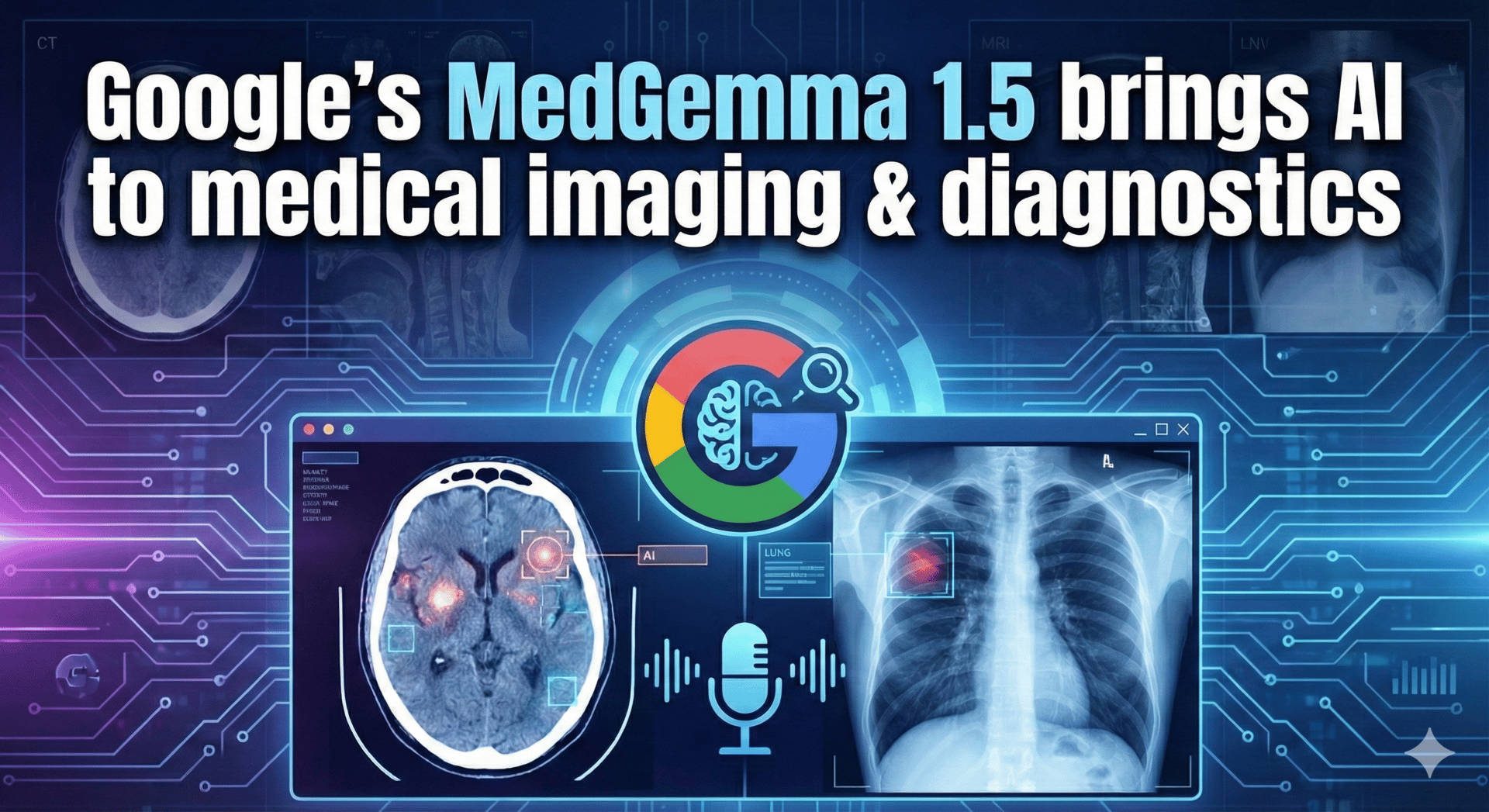
Google has released MedGemma 1.5, a significant update to its Health AI Developer Foundations, alongside MedASR for medical speech-to-text applications. The update includes support for high-dimensional medical imaging like CT scans, MRIs, and histopathology, with 35% better anatomical localization and 18% improvement on lab report extraction. MedASR complements this with specialized transcription designed for medical terminology and clinical workflows. The models remain free for research and commercial use, with Google launching a $100,000 MedGemma Impact Challenge hackathon. These updates reinforce Google's commitment to healthcare AI infrastructure and could accelerate deployment across diagnostic settings.
🤖 Instagram co-founder Mike Krieger joins Anthropic Labs 🤖
Anthropic expands internal Labs team with high-profile hires to accelerate product rollout.
Anthropic has expanded its internal Labs team dedicated to incubating experimental products at the frontier of AI capabilities. The expansion includes significant role changes and new hires: Instagram co-founder Mike Krieger joins for collaborative product development, while Ami Vora will lead the product organization alongside CTO Rahul Patil to scale Claude experiences. The announcement highlights recent successes including Claude Code's billion-dollar growth trajectory and the Model Context Protocol's emergence as an industry standard. This signals a strategic shift toward aggressive product development, challenging OpenAI's consumer-facing dominance and expanding beyond core API offerings.
🎙️ Voice AI reaches mainstream after LLM advances 🎙️
Analysis suggests vocal computing may finally overcome Siri and Alexa's limitations.
A deep analysis suggests voice AI is ready for mainstream adoption as recent breakthroughs finally overcome the fundamental limitations that plagued Siri, Alexa, and earlier voice assistants. OpenAI's recent conversational AI capabilities and its acquisition of a hardware startup signal potential development of innovative voice-driven devices moving beyond smartphone-centric interfaces. Major tech companies are refining diverse hardware form factors for AI interaction, positioning voice control as pivotal for more intuitive computing experiences. This trend matters because it could reshape consumer electronics and fundamentally alter how users interact with AI systems daily.
INTERESTING TO KNOW
🎬 Veo 3.1 adds 4K upscaling and vertical video 🎬
Google's Veo 3.1 video generation tool receives substantial upgrades for broader integration across creator platforms. Key new features include generating videos based on reference images ("Ingredients"), native vertical video output optimized for mobile, and high-resolution upscaling to 1080p and 4K. The update makes Veo more competitive against Runway and Sora, with potential YouTube Studio applications on the horizon.
🏗️ Meta commits $600B to AI infrastructure 🏗️
Meta has launched Meta Compute, a top-level initiative to build AI infrastructure at unprecedented scale with plans to add tens of gigawatts of capacity this decade and hundreds over time. The company has committed $600B in US infrastructure spending by 2028 and recently secured 20-year nuclear power agreements. Infrastructure chief Santosh Janardhan will co-lead with Daniel Gross, who joined from AI safety startup SSI. The announcement signals Meta's aggressive push to secure computing resources amid intensifying AI competition.

📩 Have questions or feedback? Just reply to this email , we’d love to hear from you!
🔗 Stay connected: